How can educational toys improve problem solving skills? The answer is not simply that children learn while playing. A wooden maze, a set of blocks, or a simple gear kit gives a child a problem they can touch, change, and test. When a tower leans, the child may widen its base. When a gear fails to turn, they can try another arrangement. These small experiments help children practice planning, noticing patterns, and adjusting ideas. Progress can be slow. That is part of the learning.
Play researcher Dr. Stuart Brown, founder of the National Institute for Play, has said, “The opposite of play is not work—the opposite of play is depression.” His words highlight why playful exploration matters, though they do not prove that every toy builds problem-solving ability. The value depends on how a toy invites children to think. Open-ended materials often allow more than one solution, while an adult’s thoughtful question can help a child explain a choice without taking over. “What could you try next?” may be more useful than giving the answer.
This introduction explores how toy design, repetition, and guided play can support practical reasoning in children. It also considers a limitation: a colorful toy is not automatically educational. Children need time, room to make mistakes, and freedom to revise their plans. And adults should be willing to observe before stepping in.
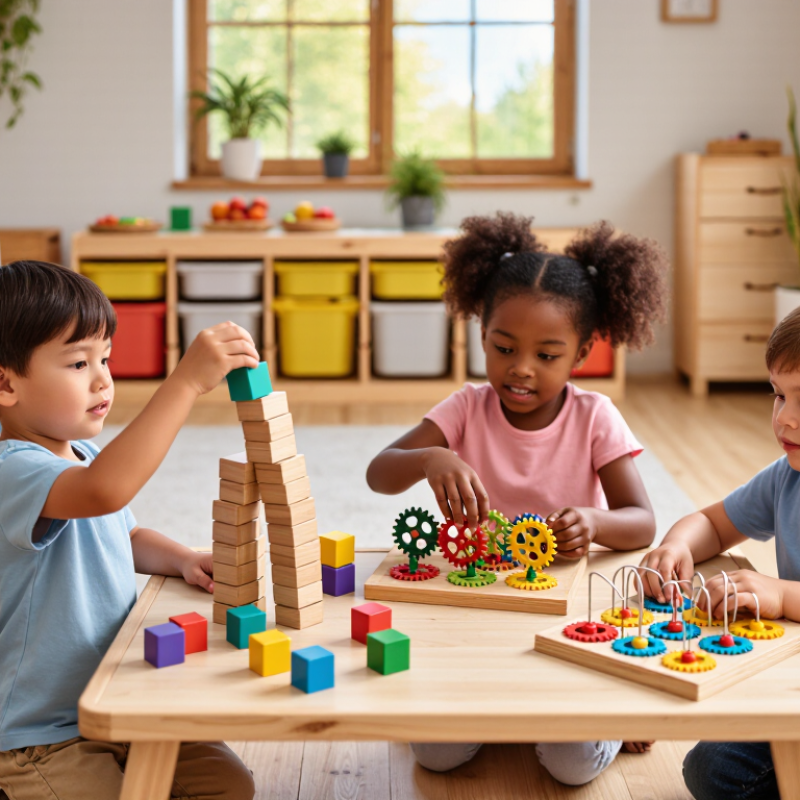
Problem solving means noticing a gap, testing possible actions, and adjusting when the first attempt fails. It is not simply finding one correct answer. The World Economic Forum’s 2023 Future of Jobs Report ranked analytical thinking as the leading core skill among employers. Its findings drew on a survey of 803 companies, representing more than 11 million workers across 45 economies. That ranking matters because employers need people who can interpret evidence, weigh options, and respond to changing situations—not just recall facts.
Educational toys can give children small, tangible problems to work through. A balance scale, for example, invites a child to compare weights and revise a guess. Building blocks make cause and effect visible: a narrow base may wobble, so the child changes the structure. These moments can encourage observation, planning, and persistence. They work best when adults ask open questions, such as “What could you try next?” rather than immediately showing the answer.
Still, a toy cannot guarantee analytical thinking. A child may enjoy fitting pieces together without explaining why a solution works. That is worth noticing. Play becomes more useful when children can describe their choices, test another approach, and learn from a failed attempt. Employers’ rankings offer a strong signal, not a complete definition of a successful learner. The challenge is making room for both focused practice and the occasional messy, unplanned discovery.
A jigsaw puzzle turns reasoning into something children can touch. A child may rotate a stubborn piece, compare its colors, then test another spot. Each attempt practices observation, prediction, and adjustment—not just patience. The challenge should feel manageable, with room for a small mistake. That matters. If an adult supplies every answer, the child gets less practice making decisions.
The skill has value beyond play. In a 2023 employer survey, the Association of American Colleges and Universities reported that 93% of employers considered critical thinking and the ability to solve complex problems more important than a candidate’s undergraduate major. Puzzles offer children an early, low-pressure way to try these habits: sorting pieces by shape, spotting patterns, and explaining why a choice might fit. A caregiver can ask, “What could you test next?” instead of pointing to the right piece. Still, a puzzle alone cannot prove that a child will solve problems well at school or work. Transfer takes practice in different situations, and some children may need a different kind of challenge. That’s worth remembering.
Construction toys turn problem solving into something children can see and touch. A child building a bridge might study the gap between two chairs, choose longer pieces, and sketch a rough plan. The plan may be ambitious. That is useful. Before building, children can predict where the bridge might bend or which base needs support. These small decisions practice planning without making the task feel like a worksheet.
Then comes testing. A toy car can roll across the bridge, or a few blocks can act as a gentle load. If the middle sags, the child has evidence, not just a mistake. They can add a support, change the spacing, and test again. This cycle teaches that solutions often need adjustment. Adults can help by asking, “What changed when you moved that piece?” rather than fixing the structure themselves. Keep the challenge manageable, and let the child handle the pieces. Frustration can build too quickly.
Not every attempt will work. Sometimes a child repeats the same design, or abandons the bridge after one collapse. That is worth noticing. A calm prompt, such as “What could you try differently?”, can reopen the experiment without taking control. Construction play does not guarantee stronger problem-solving skills on its own; children benefit from time, encouragement, and room to explain their choices. The wobbly bridge may teach more than a perfect one.
Rule-based games give children a clear problem to work through. A simple board game might ask players to reach a finish line while avoiding blocked squares. Children must notice the rules, consider possible moves, and predict what another player may do. “If I move here, what changes?” becomes a practical question, not an abstract exercise.
The rules also make strategy visible. A child may save a useful card for later, then change plans when an opponent takes an unexpected turn. That adjustment practises flexible thinking: the original plan is not always the best one. Short rounds help, too. Children can try a different approach without waiting long to see what happens. Some may need an adult to explain a rule or model thinking aloud, especially when frustration rises. Keep the game manageable. Too many rules can hide the problem-solving practice. And a child who loses interest may be telling you the challenge needs adjusting, not that they lack ability. I have seen a seemingly clever strategy fail because nobody checked one small rule. That is part of the learning, though it can be annoying. After a round, asking “What would you change next time?” helps children reflect on choices rather than focus only on winning.
Rule-based games can give children repeated chances to plan, follow constraints, respond to changing situations, and reflect on outcomes. The values shown are an illustrative scale of practice opportunities, not measured research results.
Educational toys can make problem solving visible through small, repeatable challenges. A child might build a bridge for a toy car, notice the middle sagging, then widen its base. Record what happens: the first design, the change, and whether the car crosses. These observations echo OECD’s PISA problem-solving framework, which tracks how learners explore a problem, form a plan, act, and reflect. The OECD’s PISA 2012 assessment set the OECD average at 500 points, with a standard deviation of 100. That score describes 15-year-olds, not toy users, so it should not be treated as a direct measure of a toy’s impact.
To assess growth, offer a similar task every few weeks, changing one detail, such as the bridge’s span or available blocks. Note whether the child tests ideas, explains a choice, and adapts after failure. Keep prompts consistent. A simple rubric can rate each behavior from “not yet” to “independently,” while photos preserve design changes over time. Small steps matter.
The World Economic Forum’s Future of Jobs Report 2023 identifies analytical thinking as a leading core skill among surveyed employers. This supports attention to reasoning, but it does not prove that toys cause lasting gains. Adult hints can also distort results. I’ve found that waiting quietly can reveal more than rescuing a wobbly design. Still, one successful build may be luck; repeat the task and record the struggle, too.
Children can measure a gap between two chairs and choose longer pieces for a bridge. They may predict where it could bend before building.
A toy car or a few blocks can act as a gentle load. If the middle sags, children can add support and test again.
Not right away. Ask, “What could you try differently?” and let the child move the pieces. Frustration can build quickly, though.
No. Children need time, encouragement, and room to explain their choices. A collapse is not always a useful lesson without a chance to try again.
Children follow rules, consider possible moves, and predict what another player might do. A blocked square can change their route to the finish.
A child might save a useful card, then change plans after an opponent’s unexpected turn. The first strategy may not work.
Explain one rule or model thinking aloud. Too many rules can hide the challenge, and a child losing interest may need an easier game.
Ask, “What would you change next time?” This shifts attention toward choices, not only winning. A clever move can still fail over one small rule.
Problem solving involves identifying challenges, analyzing information, testing possible solutions, and adapting when circumstances change. Its importance is reflected in the World Economic Forum’s 2023 finding that analytical thinking is the top skill sought by employers. Exploring how can educational toys improve problem solving skills begins with seeing play as a chance to practise these abilities in an engaging, low-pressure setting.
Puzzles help children develop reasoning by recognizing patterns and considering different possibilities, while construction toys encourage them to plan, test ideas, and revise designs when something does not work. Rule-based games offer practice in strategy, anticipating outcomes, and adapting to changing conditions. Progress can be assessed through age-appropriate tasks inspired by the OECD’s PISA problem-solving framework, such as presenting a practical challenge and observing how a learner defines the problem, chooses an approach, and responds to results. Together, these activities make problem solving an active skill built through repeated practice.

Fyre Toys