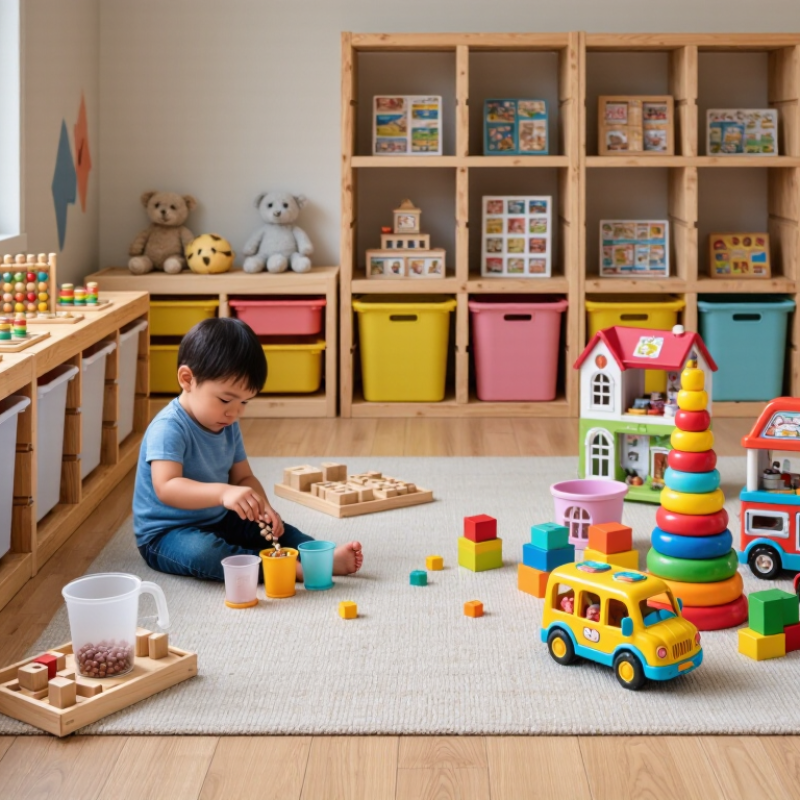
Choosing between Montessori and traditional toys is not simply a matter of wooden versus colorful. It is about how a child explores, concentrates, imagines, and solves small problems. A child may quietly pour beans between two cups, then enthusiastically build a noisy tower with plastic blocks. Both experiences can matter.
So, what is the difference between Montessori and traditional toys? Montessori materials usually isolate one skill, use simple designs, and encourage independent repetition. Traditional toys often offer broader pretend play, character-based stories, lights, sounds, or multiple functions. The distinction is useful, but not absolute. Some traditional toys support Montessori principles, while some “Montessori” products add little educational value.
Professional guidance supports thoughtful selection rather than endless purchasing. The American Academy of Pediatrics, in its clinical report Selecting Appropriate Toys for Young Children in the Digital Era, recommends toys that encourage caregiver interaction, pretend play, language, and problem-solving. UNICEF’s Early Childhood Development reports also emphasize responsive relationships and play-rich environments, not expensive products alone. Circana’s global toy market reporting shows that families continue to buy across categories, including building sets, games, and early-learning products. Sales data reveals preferences, not developmental quality.
Look closely at the playroom. Can a child reach the puzzle independently? Does the toy invite conversation, or merely flash and sing? A quiet shelf may teach focus. A pretend kitchen may teach cooperation.
There is no perfect formula. Even a carefully chosen Montessori toy may be ignored. Children remain unpredictable. This guide compares both approaches, using developmental principles, expert evidence, and practical home observations to support better decisions.
What Defines Montessori and Traditional Toys: Materials, Structure, and Purpose
How to Choose Montessori vs Traditional Toys?
Montessori toys are often made from wood, metal, fabric, or other tactile materials. Their surfaces invite children to touch, carry, stack, match, and repeat. Many have one clear challenge, such as fitting a cylinder into the correct opening. This structure supports concentration and allows children to notice mistakes without immediate adult correction.
However, natural materials alone do not make a toy Montessori. I once assumed that every wooden toy supported independent learning. That was too simple.
Traditional toys usually offer brighter colors, stronger sounds, moving parts, or familiar characters. Their structure may encourage pretend play, quick rewards, or shared games.
A toy kitchen can build language through role-play, while a puzzle can develop visual reasoning. Some traditional toys have many possible uses, even when they include batteries. The label is broad, so quality varies greatly.
Purpose matters more than appearance.
Ask what the child can do without help, how long the activity may hold attention, and whether the challenge fits current abilities. In my observations, a simple object sometimes kept a child focused longer than an expensive electronic toy.
Still, not every child enjoys quiet repetition. Some children need dramatic stories, movement, or social play. A balanced shelf may include both styles, with safe materials, manageable pieces, and enough space to use them independently.
Play should reveal interest, not test parental perfection.
Safety First: Applying CPSC Toy-Injury Data and ASTM F963 Standards
How to Choose Montessori vs Traditional Toys?
Safety should guide the choice before learning style does.
The CPSC’s Toy-Related Deaths and Injuries report for 2022 estimated
145,500 emergency-department-treated injuries
among children under 15. It also recorded
11 toy-related deaths.
These figures make a simple wooden toy worth examining, not automatically trusting.
145,500
emergency-department-treated injuries among children under 15
Montessori toys often use wood, stacking pieces, or practical tools. Traditional toys may include lights, sounds, batteries, magnets, and small detachable parts. Each design needs careful checking. Look for the child’s age label, choking warnings, sharp edges, loose cords, and accessible battery compartments. During home observations, I have found that a quiet toy can still become risky when a piece loosens. I still recheck toys after washing or dropping them. That step is easy to miss.
ASTM F963-23 addresses mechanical hazards, flammability, sound levels, chemical migration, and other toy-safety concerns. In the United States, CPSC regulations incorporate this standard through
16 CFR Part 1250.
Parents should seek clear compliance information, but paperwork is not a substitute for inspection. A two-year-old may place a tiny counting bead in their mouth within seconds. Store small components separately. Avoid guessing. Check the CPSC recall database and read the complete warning label before purchase, especially for toys containing magnets or button batteries.
Learning Outcomes: Comparing Research on Open-Ended and Guided Play
How to Choose Montessori vs Traditional Toys?
Research does not show that one toy category always wins. A 2022 meta-analysis in Child Development reviewed 39 studies involving roughly 3,800 children. Guided play produced stronger outcomes in early mathematics, task switching, and learning engagement than free play alone. The adult still protects the child’s choice. A question such as “How could this tower stand longer?” can guide thinking without controlling every move.
Open-ended toys support flexible problem-solving. A wooden block can become a bridge, bed, or pretend shop. The UNICEF Innocenti report Learning through Play identifies play as important for cognitive, social, emotional, and physical development. However, the report does not claim that every open-ended activity creates measurable academic gains. That distinction matters. A child may explore freely, yet miss a useful concept without gentle support.
Traditional guided toys can offer clear practice with counting, matching, sequencing, or letter sounds. The American Academy of Pediatrics also stresses that play works best when adults join children through conversation and shared attention. In my experience, the strongest setup mixes both approaches: loose pieces beside a simple challenge, such as building a bridge for three toy animals. Avoid over-directing. Some children need more structure, while others need uninterrupted time. Research is promising, but it remains uneven, and toy labels alone cannot predict learning.
Age and Development: Using NAEYC and AAP Play-Based Guidance
How to Choose Montessori vs Traditional Toys?
Age and Development: Using NAEYC and AAP Play-Based Guidance
Choosing between Montessori and traditional toys should begin with the child, not the label. NAEYC’s Developmentally Appropriate Practice guidance emphasizes play that is joyful, active, social, and suited to each child’s development. A simple wooden puzzle may support persistence. A pretend kitchen may build language and cooperation. Both can be valuable.
For infants, select toys with safe textures, graspable shapes, and clear cause-and-effect. Avoid expecting advanced skills too early. Toddlers often need movement, imitation, and repeated practice. Blocks, containers, dolls, and washable art materials fit these needs. Preschool children benefit from open-ended construction, storytelling, counting, and rule-based games. The American Academy of Pediatrics recommends no more than one hour of screen media daily for children aged two to five, making hands-on play especially important.
A toy can be beautiful and still be unhelpful. I have sometimes mistaken quiet play for better play. That assumption needs checking. Watch the child: Do they reach, speak, problem-solve, or invite someone else? If frustration rises quickly, simplify the task. If boredom appears, add a real-world challenge, such as sorting socks or pouring water. The AAP’s play guidance connects play with language, executive function, social skills, and emotional growth. NAEYC also stresses responsive adult support. Sit nearby. Ask fewer questions. Let the child lead.
How to Choose Montessori vs Traditional Toys?
Age and Development: Using NAEYC and AAP Play-Based Guidance
The chart translates play-based guidance into practical selection priorities by age. Scores are a guidance-alignment rubric from 0 to 3, not measures of learning outcomes. Both Montessori-oriented and traditional toys can support development when they are safe, age-appropriate, open-ended, and used with responsive adult interaction.
NAEYC emphasizes active, meaningful, play-based learning, child choice, social interaction, and developmentally appropriate practice. The American Academy of Pediatrics emphasizes simple toys, imagination, physical activity, language, executive function, and caregiver-child interaction.
Cost, Accessibility, and Family Fit: A Practical Evidence-Based Framework
How to Choose Montessori vs Traditional Toys?
Cost, accessibility, and family routines often matter more than labels. In classroom observations, simple toys supported longer, calmer play when children could choose their actions. Montessori-style materials often use wood, limited features, and one clear purpose. They can cost more, but fewer well-chosen items may reduce clutter and replacement costs. Traditional toys may offer lights, sounds, characters, and faster entertainment. They are often easier to find and cheaper during sales.
Accessibility deserves equal attention. Some children need larger handles, brighter contrast, sound, or predictable buttons. A toy is not educational if a child cannot use it independently. Evidence on play suggests open-ended materials can encourage problem-solving, language, and flexible thinking. However, the research does not prove that one toy category benefits every child. Family fit matters. A quiet wooden puzzle may suit one household, while a durable electronic toy may work better during travel or therapy. I have sometimes chosen an attractive toy that created more frustration than learning.
Tips: Set a monthly toy budget. Watch how your child plays for ten minutes. Choose one feature to support, such as grip, turn-taking, or pretend play. Check cleaning, storage, and safety instructions. Borrow before buying when possible. Ask whether the toy fits your actual evenings, not an ideal routine. A mixed shelf can be sensible. Keep the toy that earns repeated, independent use.
FAQS
It usually has one clear challenge, such as matching a cylinder to its opening. Children can touch, carry, stack, repeat, and notice mistakes independently. Wood alone is not enough.
Traditional toys may include bright colors, sounds, moving parts, characters, or pretend-play themes. A toy kitchen can encourage language and role-play. A puzzle can build visual reasoning.
Neither style is always better. Watch what your child does for ten minutes. Choose a toy that matches current abilities, interests, and attention span. I once chose appearance over usefulness. That was a mistake.
Check the age label, choking warnings, sharp edges, loose cords, and detachable pieces. Inspect toys after washing, dropping, or frequent use. A quiet wooden toy can still become unsafe.
Keep beads, tiny blocks, magnets, and button batteries away from young children. A toddler may put a small piece in their mouth within seconds. Do not guess.
Recognized safety standards address hazards such as flammability, sound, chemicals, and mechanical injuries. They help, but they do not replace regular inspection. Paperwork is not supervision.
They can cost more because they often use durable materials and fewer features. A small shelf may reduce clutter and replacement costs. Still, a cheaper toy may fit your home better.
Look for large handles, strong contrast, predictable buttons, or sound feedback when needed. A toy is not educational if a child cannot use it independently. Needs differ.
A mixed shelf can work well. Include a quiet puzzle, a stacking activity, and a pretend-play object. Keep the toy that earns repeated, independent use.
Conclusion
Choosing between Montessori and traditional toys begins with understanding their different designs and purposes. The key question is: what is the difference between Montessori and traditional toys? Montessori-inspired toys are often simple, hands-on, and open-ended, encouraging children to explore real materials, practice practical skills, and guide their own play. Traditional toys may provide more structure, storytelling, electronic features, or specific instructions, which can support guided learning and imaginative scenarios. Neither approach is automatically better; the best choice depends on the child’s age, interests, abilities, and family environment.
Safety and development should remain priorities. Parents should check for age recommendations, choking hazards, secure construction, and compliance with applicable toy-safety requirements such as ASTM F963, while using injury-prevention information from recognized public-safety authorities. Research on open-ended and guided play suggests that both can support learning when adults offer appropriate interaction without taking over. Guidance from early-childhood and pediatric organizations also emphasizes play-based experiences, movement, language, and social development. Families should balance educational value with cost, durability, accessibility, and everyday practicality.

 Fyre Toys