2026 Top Wooden Toys How Do They Encourage Imaginative Play?

Time:2026-10-17 Author:Ethan
0%

Wooden toys remain powerful tools for children who need space to imagine, experiment, and create. Unlike electronic toys, they rarely prescribe one correct action. A smooth wooden block can become a bridge, a loaf of bread, or a tiny bed for a cloth rabbit. Children decide what happens next. That decision matters.

So, how do wooden toys encourage imaginative play? They offer simple shapes, natural textures, and open-ended possibilities. A child can stack, sort, balance, build, pretend, and rebuild. Each attempt develops planning, problem-solving, language, and flexible thinking. The quiet click of blocks meeting can even invite concentration. Small details become meaningful. A painted wheel may become a train, a steering wheel, or a spaceship control panel.

Simon Nicholson, the architect behind the “Theory of Loose Parts,” wrote, “In any environment, both the degree of inventiveness and creativity, and the possibility of discovery, are directly proportional to the number and kind of variables in it.” His idea helps explain why uncomplicated materials can produce complex play. Wooden toys provide those variables through size, weight, shape, and movement.

Still, wooden toys are not automatically imaginative. A highly detailed toy can limit interpretation. Some children may also need an adult’s gentle invitation before play begins. Try adding fabric, stones, or cardboard. Watch, rather than direct. The results may look messy. That is often where authentic creativity starts. This article explores the 2026 wooden toy trends that support richer, more independent imaginative play.
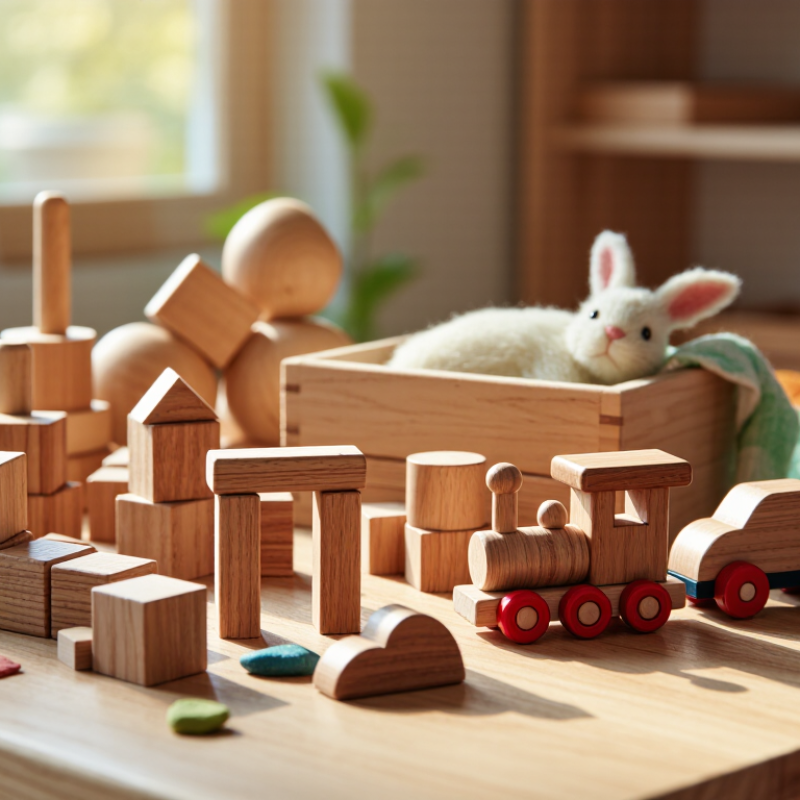
2026 Top Wooden Toys How Do They Encourage Imaginative Play?

2026 Wooden Toy Categories Under ASTM F963-23 and EN 71 Standards

Wooden toys encourage imaginative play when children can transform simple shapes into stories, tools, or characters. A block may become a bridge; a wooden kitchen set may become a busy café. Industry forecasts continue to show steady demand for educational and open-ended toys, while the U.S. CPSC’s 2023 report estimated about 231,000 toy-related injuries treated in emergency departments.

Safety categories matter under ASTM F963-23 and EN 71.
Building blocks, pull toys, puzzles, role-play sets, and early-learning toys require checks for small parts, sharp edges, structural strength, and accessible chemicals. ASTM F963-23 also addresses flammability, sound-producing features, and heavy-element migration. In Europe, EN 71-1 covers mechanical and physical properties, EN 71-2 covers flammability, and EN 71-3 evaluates the migration of certain elements.

In practical inspections, unfinished edges can hide between wooden pieces. Paint may look attractive but still needs migration testing. ASTM and EN 71 are not design shortcuts. They are verification frameworks. A responsible review should examine age grading, warnings, test reports, and traceability records. One weakness remains: standards cannot measure whether a toy truly sustains creative play. A perfectly tested toy can still offer only one scripted action. That part deserves more reflection.

Open-Ended Design and Imaginative Play: LEGO Foundation Research Findings

Open-ended wooden toys support imaginative play because they offer possibilities, not fixed outcomes. A block can become a bridge, shop counter, boat, or sleeping animal. Children decide the story, rules, and ending. The 2018 Learning Through Play research report identifies five qualities of effective play: joyful, meaningful, actively engaging, iterative, and socially interactive. Open-ended construction naturally supports these qualities through repeated building and revision.

Professional guidance strengthens this view. The World Health Organization’s 2019 early-years guidelines recommend at least 180 minutes of daily physical activity for children aged three to four. Flexible wooden play can include movement, carrying, balancing, and collaborative building. These actions connect imagination with physical experience. A 2021 OECD early-childhood education report also emphasizes play-based learning as a way to develop communication, problem-solving, and self-regulation.

Wood is not automatically imaginative. A beautifully finished toy may still control every action. The stronger design uses simple shapes, varied sizes, and minimal instructions. A child should be able to stack pieces unevenly, change the purpose, and start again. Adults can observe before helping, then ask, “What happens next?” rather than correcting the structure. This approach may feel slower. It can also reveal a weakness: some children need more prompts before open-ended play becomes comfortable. That is why thoughtful guidance, accessible pieces, and patient space matter as much as the material itself.

Pretend Play by Age: NAEYC Developmental Guidance and Play Patterns

Pretend play develops differently at each age. NAEYC’s developmentally appropriate guidance emphasizes open-ended materials, responsive adults, and realistic expectations. From 12 to 24 months, children imitate familiar routines. A wooden cup becomes a drinking cup, then a telephone. They may repeat the same action for minutes. That repetition is meaningful.

Between ages two and three, pretend play usually uses short scripts. A child may feed a wooden animal, cover it with a cloth, and say, “Sleep now.” Adults can add language without controlling the scene. The WHO and UNICEF 2019 report found that about four in five children aged two to four lack sufficient stimulating interaction and responsive engagement. A calm question helps: “Where is the animal going?” Too many questions can interrupt the story.

From three to six, children often connect roles, objects, and simple rules. A block can become a bus, a bridge, or a birthday cake. NAEYC guidance supports letting children negotiate these meanings, even when the play looks disorganized. The American Academy of Pediatrics’ 2018 clinical report links play with language, self-regulation, and executive-function development. I have sometimes corrected a child’s “wrong” use of a toy. That was unnecessary. A wooden spoon used as a microphone may show more imagination than a perfect pretend kitchen. Children need room to revise the plot, disagree, and try again.

2026 Top Wooden Toys: How They Encourage Imaginative Play

Pretend Play by Age: NAEYC-aligned developmental guidance and common play patterns

Open-ended wooden toys can support imaginative play because children may use the same object in different ways. The chart shows commonly observed pretend-play patterns across broad age ranges: object substitution, self-directed role play, assigning roles to others, and cooperative story-making. These are developmental patterns rather than fixed milestones; children may show them earlier or later.

Guidance reference: National Association for the Education of Young Children (NAEYC), developmentally appropriate practice and play-based learning guidance.

Material Safety Metrics: CPSC Small-Parts and Surface-Coating Requirements

In 2026, wooden toys still invite open-ended play: a plain block becomes a bridge, house, or small animal. That freedom depends on careful material testing. The CPSC reported 232,900 toy-related injuries treated in U.S. emergency departments in 2023, involving children under 15. This figure does not isolate wooden toys, but it shows why construction details matter.

Under CPSC rules aligned with ASTM F963-23, detachable components must be assessed with the small-parts test cylinder, measuring about 1.25 inches in diameter and 2.25 inches long. If a piece fits completely, it may present a choking hazard for children under three. Testers also examine toys after foreseeable use and abuse, including pulling, dropping, and twisting. A loose wooden wheel can pass visual inspection, then fail after repeated handling.

Surface coatings require separate attention. Lead in paint and similar coatings must not exceed 90 parts per million, while accessible substrates generally have a 100-ppm limit. Certain phthalates are restricted to 0.1% in applicable children’s toys. These numbers come from CPSC regulatory requirements, not marketing language. CPSC’s Toy-Related Deaths and Injuries report, 2023, provides useful injury context, though it does not replace laboratory certification.

I would not treat a glossy finish as proof of safety. A faint odor, chipped edge, or sticky painted surface deserves review. Testing can miss poor production control. That is the uncomfortable part.

2026 Top Wooden Toys: How Do They Encourage Imaginative Play?
Material Safety Metrics: CPSC Small-Parts and Surface-Coating Requirements

Data Dimension Measured or Defined Metric Verified Requirement or Benchmark Connection to Imaginative Play 2026 Product-Review Evidence
Open-ended play functions At least 3 distinct play scenarios using the same core pieces Examples may include building, pretend cooking, rescue play, sorting, or storytelling Multiple possible uses allow children to assign their own roles, rules, and narratives rather than following one fixed outcome. Review the instruction design, accessory mix, and whether pieces can be recombined without a single required result.
Loose-part variety Minimum of 4 visually or functionally different piece types Useful combinations include blocks, figures, wheels, panels, connectors, or shape pieces Different forms support symbolic substitution, construction, character creation, and changing story settings. Count the piece categories and record whether each category has more than one possible role.
Child-directed configuration At least 2 stable configurations beyond the illustrated example Configurations should be achievable without tools or permanent assembly Rebuilding lets children test ideas, revise plans, and create new environments for pretend play. Photograph two or more child-created arrangements that differ from the packaging image.
Age-grade suitability Age grade must match the toy’s complexity, foreseeable use, and component size Toys intended for children under 3 must comply with the applicable small-parts prohibition in 16 CFR Part 1501. Appropriate complexity helps children engage independently while reducing frustration and unsafe misuse. Compare the stated age grade with developmental demands, foreseeable handling, and the smallest detachable components.
Small-parts dimensional screen Component fits entirely inside a small-parts test cylinder measuring approximately 31.7 mm in diameter by 57.1 mm in length For toys intended for children under 3, a component that fits entirely in the cylinder is generally treated as a prohibited small part, subject to applicable regulatory exceptions. Safe component sizing allows children to manipulate pieces for pretend scenarios while addressing ingestion and choking hazards. Perform dimensional screening on every detachable part and on parts released after required use-and-abuse testing.
Use-and-abuse small-parts assessment Evaluate parts after foreseeable impact, torque, tension, compression, and drop tests Testing should follow the applicable requirements of 16 CFR Part 1500.50–53 and the relevant toy-safety standard. Durable pieces preserve open-ended play opportunities without creating newly detached hazards during normal child interaction. Record detached components, sharp edges, splinters, cracks, and any piece that becomes small enough to enter the test cylinder.
Lead in surface coatings Maximum lead concentration: 90 ppm by weight in paint or similar surface coating U.S. limit under the Consumer Product Safety Improvement Act and 16 CFR Part 1303. Low-lead coatings support safer tactile, role-play, and handling experiences, especially where children frequently touch painted surfaces. Use representative coating samples from each distinct color or finish and retain laboratory test reports.
Lead in accessible substrate Maximum lead content: 100 ppm by weight in accessible parts of the substrate CPSIA Section 101 limit for accessible component parts, subject to statutory and regulatory provisions. A safe unfinished or exposed wooden surface supports repeated handling, construction, and pretend-play contact. Test accessible wood, metal, plastic, or other substrate materials separately where required by the compliance plan.
Toy-safety standard alignment Applicable requirements of ASTM F963, including mechanical, physical, flammability, and chemical provisions ASTM F963-23 became the mandatory toy-safety standard through 16 CFR Part 1250 for applicable U.S. toys from April 20, 2024. A broad safety review helps keep imaginative features usable without excessive breakage, hazardous edges, or unsafe materials. Maintain a test matrix covering the toy’s age grade, materials, moving parts, coatings, magnets, and foreseeable play conditions.
Surface durability and splinter control No accessible splinters, hazardous sharp points, or coating flakes after intended-use and applicable abuse testing Evaluate under applicable ASTM F963 mechanical and physical requirements and general product-safety principles. Smooth, durable surfaces encourage repeated building, carrying, role-play, and collaborative play. Inspect edges, corners, drilled holes, joints, and painted surfaces before and after testing.
Documentation and traceability Test reports linked to a defined production sample, material specification, and manufacturing lot Children’s products generally require applicable third-party testing and certification documentation under U.S. CPSC rules. Reliable documentation supports consistent safety across replacement pieces and future versions of an imaginative-play set. Track material certificates, laboratory reports, age grading, production dates, and corrective actions in one compliance file.

Reference framework: U.S. Consumer Product Safety Commission requirements under 16 CFR Parts 1303, 1500, and 1501; CPSIA Sections 101 and 108; and the applicable mandatory toy-safety standard in 16 CFR Part 1250. Product-specific compliance depends on age grading, design, materials, and intended use.

How to Rank Top Wooden Toys by Play Value, Safety, and Durability Data

To rank the 2026 top wooden toys, I would score play value, safety, and durability separately. Play value receives 40% because open-ended pieces can become a bridge, shop, animal, or rocket. The American Academy of Pediatrics’ clinical report links play with language, self-regulation, and problem-solving development. That evidence supports flexible designs over toys with only one scripted function. Repetition matters too. A toy that invites new stories each week earns more points.

Safety receives 35%. The U.S. Consumer Product Safety Commission reported an estimated 231,100 toy-related emergency-department injuries in 2023. Therefore, I check loose parts, sharp edges, coatings, magnets, and age labeling before judging appearance. Testing should align with recognized requirements such as ASTM F963 or EN 71. Small parts deserve special attention. They are easy to overlook.

Durability receives 25%. I look for solid joints, smooth-grained wood, stable paint, and resistance to drops, twisting, and repeated cleaning. The European Commission’s Safety Gate reports show that toy recalls commonly involve injury, choking, and chemical risks, so construction quality cannot be separated from safety. My scoring model is not perfect. A heavier toy may survive longer but frustrate younger children. A lighter toy may encourage handling yet break sooner. I record actual use after weeks of play, not just the first unboxing. That is where rankings become more honest.

FAQS

Why do open-ended wooden toys support imaginative play?

They offer possibilities instead of fixed outcomes. A block can become a bridge, shop counter, boat, or sleeping animal. Children create the story, rules, and ending. The play changes with each session.

What makes an open-ended toy effective?

Simple shapes, varied sizes, and few instructions usually work well. Children can stack pieces unevenly, rebuild them, and change their purpose. A toy should invite action. It should not control every move.

Can wooden play support physical development?

Yes. Children can carry, balance, stack, and move around while building. These actions connect imagination with physical experience. Some structures may wobble or collapse. That failure can encourage another attempt.

How should adults support open-ended play?

Adults can observe before helping. Ask, “What happens next?” instead of correcting the structure. Offer prompts when a child seems unsure. Too much guidance may reduce discovery. This balance is not always easy.

What safety issue matters most with small wooden pieces?

Detachable pieces must be checked carefully. A piece fitting completely inside a small-parts test cylinder may create a choking risk. This concern is especially important for children under three. Loose wheels deserve attention.

Are smooth surfaces and glossy paint enough to prove safety?

No. A glossy finish proves very little. Check for chipped edges, strong odors, sticky paint, and loose joints. Coatings should meet applicable limits for restricted substances. Visual inspection can miss production problems.

How can wooden toys be ranked fairly?

Score play value, safety, and durability separately. For example, play value may receive 40 percent, safety 35 percent, and durability 25 percent. This is only a working model. Actual use should influence the final judgment.

What durability details should buyers examine?

Look for stable joints, smooth wood, secure paint, and resistance to drops. Twisting and repeated cleaning also reveal weaknesses. A heavy toy may last longer but frustrate younger children. A lighter toy may break sooner. Real use tells more.

Conclusion

This guide explores how do wooden toys encourage imaginative play by focusing on open-ended designs that allow children to invent stories, build settings, solve problems, and adapt play rules over time. It reviews major wooden toy categories through the safety expectations of ASTM F963-23 and EN 71, while connecting pretend-play choices to age-related developmental guidance and common play patterns. Simple blocks, figures, puzzles, vehicles, and role-play accessories can support creativity without limiting children to one intended outcome.

The article also explains how to evaluate toy quality using practical evidence, including small-parts precautions, surface-coating requirements, material durability, and construction strength. A balanced ranking method considers play value, safety, longevity, and the ability to support independent or cooperative play. By combining developmental usefulness with responsible material and design standards, families and educators can identify wooden toys that encourage imaginative thinking while remaining suitable for everyday play.

Ethan

Ethan

Ethan is a seasoned marketing professional with a deep expertise in our company's innovative product line. With a passion for sharing knowledge and insights, he takes the lead in regularly updating our corporate blog, where he explores industry trends, product features, and effective marketing......